Resolve conflicting call rules before customizing a flow
A tailored path still needs one business decision at each fork.
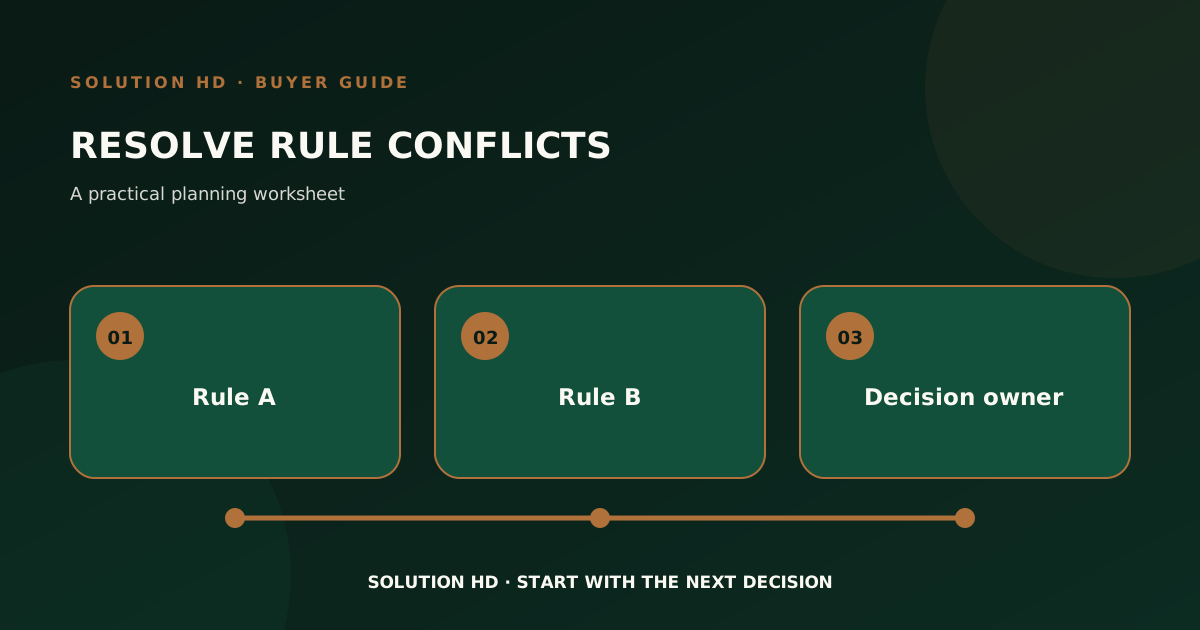
When two call instructions conflict, do not solve the disagreement by adding another branch. Write the caller situation, both proposed rules, and the person authorized to choose. A custom flow can reflect a decision your business makes; this article does not promise that any particular exception or integration is supported.
Put both instructions in the same frame
One team may say, “Send all account questions to service.” Another may say, “Send billing changes to finance.” The caller asks to change a billing contact and report a service issue. Both instructions may be relevant. Before design, separate the two requests and identify who owns each. Do not assume the call can be transferred twice or that account details can be shared without authorization.
Use a short conflict card:
| Caller situation | Rule A | Rule B | Decision owner | Temporary human path |
|---|---|---|---|---|
| One anonymized example | Exact business instruction | Competing instruction | A named role | What your team actually permits |
The example is illustrative. It is not a customer implementation or a Solution HD configuration screen.
Resolve the rule, then test the edge
Ask the decision owner which rule controls, what missing fact would change the answer, and what a caller should hear while that fact is unknown. Record the decision in language a receiving team can review. Test it against the original example and a near miss: what if the caller asks only about the billing contact, or only about service? A rule that works for one sentence may fail for the adjacent one.
The custom-flow discovery guide helps collect broader requirements; the post-design review is useful when rules change later. To bring a genuinely nonstandard call path into a conversation, contact Solution HD.