What to Revisit in a Custom Call Flow After Design
Operating rules change as a business runs; here is how to review new caller patterns, re-align human exception routes, and approve revised rules before updating your flow.
When an organization operates with non-standard inbound requirements—such as multi-tiered service qualification, department-specific routing, complex scheduling criteria, or strict escalation boundaries—an off-the-shelf call template quickly falls short. That is why tailored call flows are built through consultative discovery: mapping caller intents, codifying business logic, and creating intentional routes for live human intervention.
However, no business operates in a permanent freeze-frame. After an initial call flow is designed, configured, and deployed, daily operations inevitably shift. New service lines are introduced, staffing models evolve, seasonal volume creates bottlenecks, and callers ask questions that never surfaced during initial whiteboard sessions.
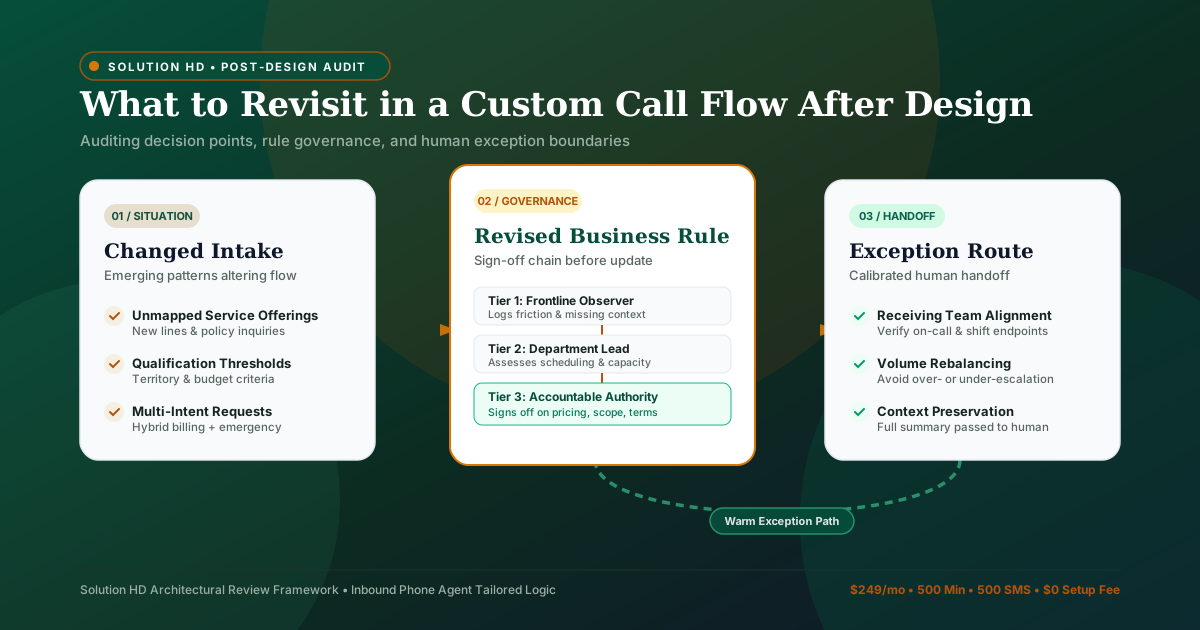
When an inbound flow begins to feel out of sync with daily operations, the answer is rarely a complete system overhaul. Instead, an operations owner must conduct a structured post-design call-flow review centered on three fundamental questions:
- Which new caller situations change an established decision point?
- Which exception or human handoff route needs re-discussion with receiving teams?
- Who inside the business holds the authority to approve the revised business rule?
Under the Solution HD phone service terms, establishing an initial flow is sales-assisted, and later changes can be made in the platform, with support available for additional assistance. But before you log into a platform or alter a live prompt, you must evaluate the operational logic behind the call.
Here is how to audit your tailored call flow after initial design to ensure your phone agent continues to reflect how your business actually runs.
1. Spot the new caller situations that alter a decision point
In custom call-flow architecture, a decision point is a juncture where a caller’s response dictates the subsequent path of the conversation. It is where the agent evaluates information—such as an account type, a requested service, a geographic location, or an urgency indicator—and selects an appropriate route.
As discussed in our guide on mapping decision points before configuration, initial design captures the predictable branches of your workflow. But after go-live, callers introduce unexpected variables.
To determine whether a decision point needs revision, look for four common operational signals:
A. Unmapped services or policy inquiries
When your business introduces a new service offering, discontinues an older package, or alters basic customer policies (such as diagnostic fees or cancellation windows), callers will inquire about them immediately. If your call flow has not been updated with approved answers and routing logic for that offering, the agent either defaults to generic information or drops the caller into an unguided fallback path.
B. Shifting qualification thresholds
Initial call flows often establish explicit qualification criteria—for example, geographic service boundaries, minimum project budgets, or required system models. When business capacity changes (such as expanding into an adjacent county or increasing project minimums), existing qualification questions will route callers based on outdated criteria. Reviewing the flow ensures your qualifying rules reflect current operating boundaries.
C. Hybrid and multi-part caller requests
During initial discovery, flows are often mapped around single-intent callers (e.g., someone calling only to book an inspection, or only to ask about billing). In practice, callers frequently combine needs: “I need to pay last month’s invoice, and I also need an emergency technician dispatched tomorrow morning.” When multi-intent patterns recur, your decision points must be refined to capture the primary urgency first without discarding secondary administrative requests.
D. Downstream friction reported by staff
The clearest evidence of a drifting decision point comes from frontline staff who receive routed calls or message summaries. If sales representatives complain that inbound leads lack essential project scope, or if technical dispatchers receive calls intended for general customer service, a decision point is either asking the wrong intake question or misinterpreting the caller's intent.
Review Principle: A decision point should change only when the operational choice behind it changes. Do not multiply branches simply because callers phrase questions differently; revise the branch when the business outcome must diverge.
2. Re-evaluate exception routes and human handoff boundaries
In a bespoke inbound agent, an exception route is not a system failure. It is an intentional, pre-planned operational protocol for scenarios that require human judgment, empathy, or specialized authority.
As noted in our custom call-flow discovery checklist, defining the handoff boundary is essential during initial setup. But after a flow has handled live traffic for several months, exception paths often require re-negotiation.
When auditing your exception routes, examine four critical operational factors:
A. Structural changes in the receiving team
Who receives an escalated call or an urgent message? In many organizations, internal roles change frequently. An on-call supervisor might transition to another division, a department might implement rotational shifts, or a direct-transfer extension might be reassigned. If your exception route transfers calls or sends high-priority notifications to inactive endpoints, caller trust is broken immediately.
B. Escalation volume imbalances
Examine whether your exception thresholds are calibrated correctly:
- Over-escalation: If frontline staff are routinely interrupted by callers who only needed basic, approved business facts or standard scheduling, the exception threshold is too sensitive. This exhausts team capacity and defeats the purpose of an inbound agent.
- Under-escalation: If callers with complex, sensitive, or high-value issues are kept in automated qualification branches when they clearly require an experienced manager, customer frustration rises. The exception path must be widened to allow faster human access for verified edge cases.
C. Context preservation during handoffs
When an inbound call escalates to a live person or generates an urgent callback notification, what context travels with it? A successful handoff must deliver the caller’s verified details, stated issue, and the specific reason for escalation. If receiving personnel find themselves asking the caller to repeat information already provided to the agent, the handoff payload needs restructuring.
D. Re-evaluating high-stakes or emergency criteria
Every business with non-standard operations has specific scenarios that demand immediate escalation—such as active property damage, regulatory inquiries, or severe client disputes. As your risk posture evolves, your definition of an “urgent exception” must be revisited with team leadership to ensure critical calls never stall in standard message queues.
3. Establish clear governance: Who approves the revised business rule?
A tailored inbound call flow touches multiple facets of an organization: customer experience, sales qualification, dispatch logistics, and operational liability. Consequently, changing a business rule in an active flow cannot be treated as an informal, ad-hoc task.
If a customer service supervisor tweaks an intake script without consulting the dispatch team, or if a sales manager alters qualification questions without checking technician capacity, the entire call workflow becomes misaligned.
To maintain operational integrity, establish a formal three-tier review and approval chain:
[ Tier 1: Frontline Observer ]
Logs real-world friction, unmapped caller questions, and handoff breakdowns.
            │
            ▼
[ Tier 2: Functional Department Lead ]
Evaluates workflow impact, scheduling feasibility, and team capacity.
            │
            ▼
[ Tier 3: Accountable Business Authority ]
Formally signs off on policy changes, pricing disclosures, and platform updates.
1. Frontline Observer (Intake & Dispatch Staff)
- Role: Identifies where the current flow breaks down in day-to-day practice.
- Responsibility: Documents specific instances where callers were misrouted, where essential context was missing from an intake summary, or where unhandled questions caused caller confusion.
2. Functional Department Lead (Service, Sales, or Operations Manager)
- Role: Validates the operational impact of a proposed change.
- Responsibility: Assesses whether the department has the resources to handle a revised routing path, confirms updated scheduling rules, and ensures that proposed script adjustments align with team procedures.
3. Accountable Business Authority (Operations Owner or General Manager)
- Role: Holds final business authority for public-facing commitments and legal policies.
- Responsibility: Signs off on any rule revision that impacts pricing disclosures, cancellation terms, service area guarantees, or liability boundaries before the change is executed in the platform.
By requiring formal sign-off from the accountable business authority, organizations prevent conflicting rules and maintain a documented audit trail of their customer communication policies.
4. Buyer-side rule review worksheet
Before initiating call-flow adjustments, use this blank, structured review worksheet to audit your operating rules internally. Documenting the original rule, the observed operational trigger, the proposed adjustment, and the designated approver ensures that every change is intentional and cross-functionally vetted.
| Decision Point / Rule Area | Original Inbound Rule & Branch | Observed Caller Situation / Operational Trigger | Proposed Revised Business Rule | Human Exception / Fallback Route | Receiving Department / Staff | Business Approver & Sign-Off Date |
|---|---|---|---|---|---|---|
| Service Qualification | Example: Qualify residential and light commercial HVAC requests. | High-frequency inquiries for heavy industrial refrigeration units. | Add explicit screening for industrial vs. commercial equipment; decline industrial. | Offer structured callback for industrial consulting team. | Commercial Sales Desk | [ ] Approved by Ops Dir (YYYY-MM-DD) |
| Geographic Boundary | [Document current county/zip rules] | [Document out-of-area call volume or expansion] | [State proposed expanded or restricted boundary] | [Define routing for out-of-boundary inquiries] | [Designate receiving inbox or team] | [ ] Approved by: ____________ Date: ________ |
| Pricing / Diagnostic Fee | [Document current fee disclosure script] | [Document policy update or fee structure change] | [State updated approved wording for rates/estimates] | [Define escalation when caller disputes fee] | [Designate billing or office supervisor] | [ ] Approved by: ____________ Date: ________ |
| Scheduling Availability | [Document standard booking windows and lead times] | [Document technician backlogs or emergency slots] | [State updated booking logic and buffer rules] | [Define route when caller requires immediate same-day slot] | [Designate on-call dispatch lead] | [ ] Approved by: ____________ Date: ________ |
| After-Hours Escalation | [Document current after-hours emergency trigger] | [Document non-urgent callers claiming false emergencies] | [Refine strict criteria for true emergency dispatch] | [Define routing for urgent vs. next-day message] | [Designate on-call technician line] | [ ] Approved by: ____________ Date: ________ |
| Handoff Context | [Document fields currently passed during transfer] | [Document feedback from receiving staff on missing data] | [Specify new required fields before transfer occurs] | [Define fallback if caller refuses required field] | [Designate triage team] | [ ] Approved by: ____________ Date: ________ |
(Note: This worksheet is a buyer-side operational planning tool. It organizes internal decisions prior to updating your call flow; it does not represent an automated platform software module or delivery commitment.)
5. How call flow changes and commercial terms work with Solution HD
Understanding how Solution HD structures onboarding, platform maintenance, and ongoing phone service ensures your operational updates proceed without administrative friction.
Sales-assisted initial setup versus in-platform ongoing changes
Solution HD balances hands-on expertise with self-serve flexibility:
- Initial Call Flow Setup: When you begin service, you do not start with a blank screen or a rigid generic template. A sales agent works directly with you to establish your initial call flow based on your business information, decision points, and custom routing preferences.
- Ongoing Flow Maintenance: After your flow is live, your operations evolve. As stated in our Terms of Service, later changes can be made directly in the platform, and support is available for additional assistance. When your review worksheet identifies an approved rule revision, your team can implement updates in-platform or coordinate with support for complex branch adjustments.
Predictable, transparent subscription terms
Solution HD operates under clear, published subscription terms:
- Base Subscription: The standard AI Phone Agent subscription is $249 per month, billed month to month.
- No Setup or Onboarding Fees: There is no setup fee or onboarding fee ($0). Hands-on sales assistance during initial setup is included in the base subscription.
- Included Usage Allowances: Each monthly billing period includes 500 inbound voice minutes and 500 SMS text messages.
- Metered Overages: Usage beyond monthly allowances is billed at $0.15 per additional minute and $0.03 per additional SMS.
- Billing Flexibility: You may cancel before the end of the current billing period to prevent renewal. Phone service remains active through the paid period, and incurred overages remain due. Prepaid monthly service refunds are evaluated case by case.
A clear distinction: Solution HD vs. Solutions HD
It is important to maintain clarity across our portfolio brands:
- Solution HD (
solutionhd.com): Delivers tailored, consultative inbound call flows configured around non-standard operational paths, unique qualification scripts, multi-tier escalation preferences, and business-specific rules. - Solutions HD (
solutionshd.com): Delivers productized, ready-made inbound phone agents selected from a catalog of pre-built packages (such as standard reception, appointment booking, or support line) for businesses with straightforward, common calling jobs.
If your call handling requires custom decision mapping, bespoke routing logic, and hands-on operational tuning, Solution HD provides the consultative architecture required.
6. Illustrative scenario: How a commercial equipment provider reviews their post-design call flow
To see how an operations team applies this post-design review framework in practice, consider the following illustrative example:
Illustrative Example
A mid-sized commercial refrigeration and HVAC service provider based in Omaha, Nebraska, deploys Solution HD to handle inbound calls across three service divisions: planned preventative maintenance, commercial kitchen emergency repair, and equipment warranty support.
- Initial Setup Context: During initial sales-assisted configuration, the company mapped three primary decision points: (1) In-warranty vs. out-of-warranty service, (2) Emergency food-storage breakdown vs. routine maintenance, and (3) Geographic service territory within a 45-mile radius. Incurred calls were routed accordingly, with after-hours emergencies transferring to an on-call dispatch supervisor.
- Step 1: Identifying Changed Caller Situations: Three months post-launch, the company launched a new “Industrial Chillers” specialty division and expanded its territory to 75 miles for contracted corporate clients. However, callers with industrial chiller failures were getting categorized as routine commercial calls, causing delay, while out-of-county contract clients were being declined by the legacy 45-mile screening rule.
- Step 2: Re-evaluating Exception Routes: The service dispatch team reported an escalation breakdown: after-hours emergency calls were transferring directly to the dispatch supervisor’s mobile phone even when the caller was an uncontracted residential homeowner seeking private air conditioning repair. The team needed a tighter qualification gate so only contracted commercial clients triggered immediate live phone transfers after 6:00 PM.
- Step 3: Business Approval & Governance: The Service Dispatch Lead completed an internal Rule Review Worksheet proposing two specific rule revisions: (1) Add an initial triage question distinguishing residential callers from commercial facilities, routing residential inquiries to a daytime callback message, and (2) Update the emergency transfer logic to verify commercial contract status before executing a live after-hours transfer. The Vice President of Operations formally signed off on the revised policy on October 4.
- Step 4: Executing the Update: Using the platform’s management interface with guidance from Solution HD support, the operations lead updated the qualification prompts and adjusted the after-hours routing rule. Testing calls verified that residential inquiries were cleanly captured as messages, while commercial chiller emergencies transferred seamlessly to on-call technicians.
This scenario is an illustrative example designed to demonstrate internal operational review and governance; it does not represent an actual client endorsement, specific contract performance, or guaranteed response outcome.
7. Keep your custom call flow aligned with your business
A custom inbound call flow should not remain rigid while your business changes around it. By scheduling regular operational reviews, your team can ensure that every decision point reflects current service boundaries, every human exception route protects staff capacity, and every rule modification carries proper executive authority.
- Ready to establish or refine a bespoke inbound flow? Book a call-flow consultation or start AI Phone Agent service directly.
- Exploring our implementation process? Review How Solution HD Works.
- Preparing for an initial build? Use our Custom call-flow discovery checklist.
- Reviewing core decision architecture? Consult Map the decision points before you configure the call flow.
- Evaluating off-the-shelf vs. bespoke needs? Read When a custom call flow is a better fit than a ready-made path.
- Questions about coverage and terms? Explore our FAQ or review our full Terms of Service.