Bespoke Call Flow Implementation Stages: Discovery to Governance
Deploying a custom inbound phone flow is an operational commitment, not a template flip—here is how to govern discovery, configuration, pre-launch review, and change management.
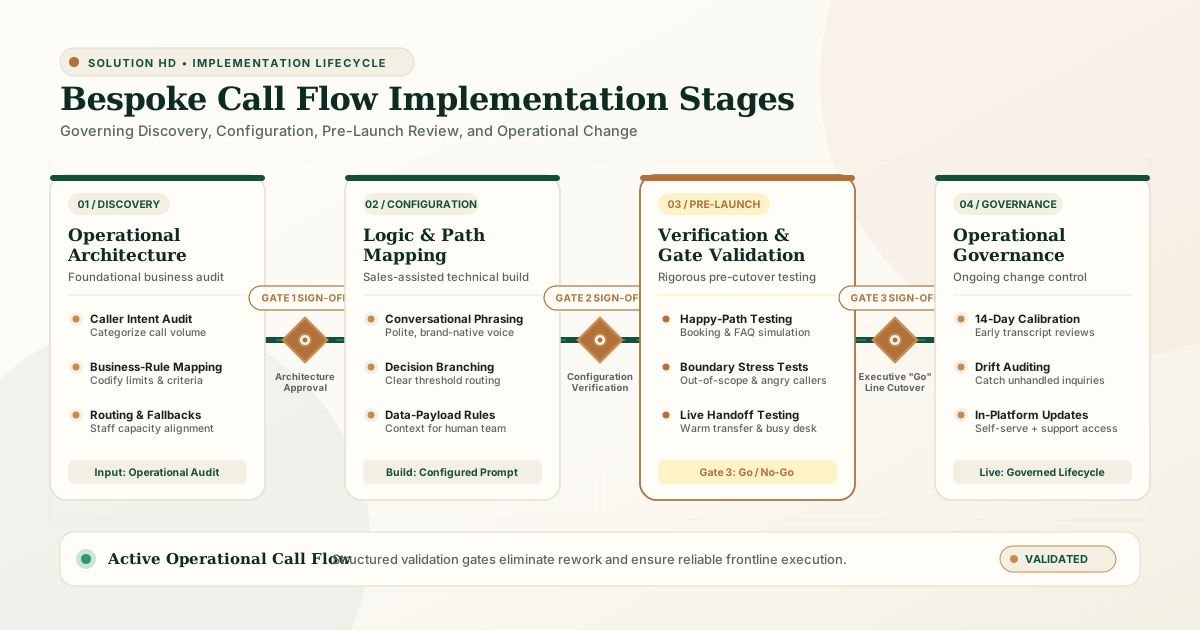
When an organization operates with non-standard inbound requirements—such as multi-facility clinical triage, complex commercial trade scheduling, department-specific routing rules, or strict regulatory disclaimers—deploying an inbound phone agent is an operational commitment, not a quick software toggle.
Off-the-shelf templates fail in these environments because they assume every caller fits a generic, linear path. In reality, complex businesses handle nuanced edge cases, tiered escalation priorities, and varied customer expectations. Deploying a tailored inbound call flow requires engineering conversational logic that accurately mirrors how the business operates in the field.
However, many operations leaders find themselves trapped between two undesirable deployment models:
- The rushed self-serve template: A vendor promises an agent “live in 48 hours,” leading to skipped discovery, untested prompt logic, misdirected transfers, and frustrated callers.
- The bloated consulting engagement: A traditional systems integrator sells an unwieldy six-month scope of work with endless billable hours, proprietary tooling lock-in, and rigid project overhead that fails to adapt to real-world operational changes.
The direct answer is that operations leaders successfully deploy bespoke call flows by executing four disciplined implementation stages bounded by formal sign-off gates: (1) Discovery & Operational Architecture, (2) Logic Configuration & Path Mapping, (3) Pre-Launch Verification & Gate Validation, and (4) Operational Governance & Change Management. Crucially, progression between stages is governed by verifiable operational criteria—not arbitrary vendor turnaround promises or artificial calendar deadlines.
By establishing clear exit gates between discovery, configuration, pre-launch testing, and ongoing maintenance, an organization ensures that its phone agent remains accurate, resilient, and fully aligned with receiving frontline teams.
1. Stage 1: Discovery & Operational Architecture
The most critical stage of bespoke implementation occurs before anyone configures an agent prompt, provisions a phone line, or tests an integration. Discovery & Operational Architecture is the foundational stage where business leadership, department managers, and frontline staff codify the operating rules that govern incoming calls.
As outlined in our guide on what a custom call-flow discovery should cover, discovery is not a passive intake form; it is an active operational audit.
┌─────────────────────────────────────────────────────────────┐
│             STAGE 1: DISCOVERY & ARCHITECTURE               │
├──────────────────────────────┬──────────────────────────────┤
│ 1. Caller Intent Audit       │ Who calls, why, and volume?  │
│ 2. Business-Rule Mapping     │ What qualifications apply?   │
│ 3. Department Routing Matrix │ Who receives each inquiry?   │
│ 4. Handoff & Fallback Rules  │ What happens if busy/closed? │
└──────────────────────────────┴──────────────────────────────┘
                               │
                               ▼
                [ GATE 1: ARCHITECTURE SIGN-OFF ]
           Cross-functional consensus on business rules
During Stage 1, the implementation team must resolve four operational pillars:
- Caller Intent Audit: Categorizing incoming call volume into discrete functional intents (e.g., routine inquiries, high-value service bookings, administrative account checks, emergency escalations).
- Business-Rule Codification: Documenting specific operational boundaries, such as geographic service areas, acceptable property or equipment types, fee disclosures, licensing constraints, or cancellation policies.
- Department Routing Matrix: Defining the destination endpoints for every call path—identifying which team, calendar, or ticketing queue owns each specific caller outcome.
- Handoff and Fallback Protocols: Establishing clear rules for when a call must transfer to a human team member, what context must travel with that transfer, and what secondary fallback occurs if the receiving desk is unavailable or after hours.
Gate 1 Sign-Off Criteria (The Discovery Gate)
Before moving into technical configuration, the project owner and department heads must formally approve the discovery documentation:
- All caller intents and operational boundaries are documented in writing.
- Receiving department leads have confirmed that routing destinations and handoff rules match their daily staffing capacity.
- Human escalation fallbacks (e.g., voicemail dispatch, on-call alert, emergency mobile transfer) are verified.
- Key stakeholders have completed our discovery checklist for complex paths.
Implementation Principle: Never begin technical configuration while business rules remain disputed. If sales and service disagree on qualification thresholds, configuring an agent merely automates internal confusion.
2. Stage 2: Logic Configuration & Path Mapping
Once the operational architecture is signed off, the project advances to Stage 2: Logic Configuration & Path Mapping. In this stage, the documented business rules are translated into precise conversational branching logic, prompt instructions, and routing behaviors.
Under Solution HD's consultative service model, establishing an initial call flow is sales-assisted: our team works directly with your operational stakeholders to configure the agent to your exact specifications, rather than handing you an empty prompt box.
┌─────────────────────────────────────────────────────────────┐
│           STAGE 2: LOGIC CONFIGURATION & MAPPING            │
├──────────────────────────────┬──────────────────────────────┤
│ 1. Conversational Phrasing   │ Natural, polite intake       │
│ 2. Decision-Point Branching  │ Evaluation thresholds        │
│ 3. Escalation Triggers       │ Sensitive / urgent routing   │
│ 4. Data-Payload Definition   │ Summary fields for handoff   │
└──────────────────────────────┴──────────────────────────────┘
                               │
                               ▼
                [ GATE 2: CONFIGURATION SIGN-OFF ]
           Structural validation against discovery specs
Key focus areas during Stage 2 include:
- Conversational Phrasing and Tone: Ensuring the agent communicates in a professional, brand-appropriate voice that reflects your organization's standards. Questions must gather necessary operational data without subjecting the caller to a rigid, robotic interrogation.
- Decision-Point Logic: Structuring the conditional branches where caller answers dictate the conversation path. As detailed in our guide on mapping decision points before configuration, each branch must resolve cleanly into a scheduled appointment, an informative resolution, a structured message, or a live transfer.
- Escalation Triggers: Codifying immediate transfer triggers for agitated callers, safety emergencies, or complex situations that fall outside the agent's designated scope.
- Data-Payload Standardization: Formatting the intake summary (caller name, verified callback number, service address, operational need, and urgency level) so that receiving staff can review context instantly upon transfer or message delivery.
Gate 2 Sign-Off Criteria (The Configuration Gate)
Transitioning from configuration to pre-launch review requires verifying that the build matches the architectural blueprint:
- Prompt instructions reflect all approved business rules, pricing disclosures, and operational limits.
- Decision branches account for negative or ambiguous caller inputs (e.g., caller unsure of account number or address).
- Transfer phone numbers and notification webhooks/inboxes are verified and active.
- Test telephone numbers are provisioned for staging and simulation runs.
3. Stage 3: Pre-Launch Verification & Gate Validation
Stage 3 is where theoretical design meets operational reality. Pre-Launch Verification & Gate Validation is a controlled, rigorous testing phase conducted before any live customer phone lines are cut over to the new agent.
A bespoke call flow should never debut in front of paying customers without structured simulation. In this stage, internal teams execute deliberate test calls designed to test every branch, edge case, and failure mode.
┌─────────────────────────────────────────────────────────────┐
│            STAGE 3: PRE-LAUNCH VERIFICATION                 │
├──────────────────────────────┬──────────────────────────────┤
│ 1. Happy-Path Simulation     │ Standard intake & booking    │
│ 2. Boundary & Stress Testing │ Out-of-scope & angry callers │
│ 3. Live Handoff Verification │ Warm transfer & fallbacks    │
│ 4. Stakeholder Blind Testing │ Department leads place calls │
└──────────────────────────────┴──────────────────────────────┘
                               │
                               ▼
                 [ GATE 3: GO / NO-GO SIGN-OFF ]
           Final operational sign-off before line cutover
The pre-launch testing protocol must execute three distinct test suites:
1. Happy-Path Verification
Verifying that routine, well-behaved callers experience a seamless interaction:
- Routine service qualification and appointment request capture.
- Standard FAQ handling (hours, location, accepted payment methods).
- Accurate intake data capture and clean transcription.
2. Edge-Case and Boundary Stress Testing
Deliberately testing the boundaries of the system to ensure graceful handling:
- Out-of-Boundary Inquiries: Callers requesting unapproved services or outside operating territories. The agent must politely decline or redirect according to approved business rules.
- Ambiguous or Incomplete Responses: Callers who provide vague descriptions or refuse specific questions. The agent must seek clarification without looping endlessly.
- Blended or Compounded Needs: Callers who present two distinct issues simultaneously (e.g., a billing dispute combined with an emergency service request). The agent must prioritize urgency and route accordingly.
3. Live Handoff and Fallback Verification
Testing the human-in-the-loop transition under realistic conditions:
- Warm Transfer Execution: Confirming that live call transfers connect to the intended team member with appropriate caller context announced.
- Unanswered Transfer Fallback: Simulating scenarios where the human team is busy, on another line, or away from the desk. The agent must gracefully recover, apologize for the unavailability, capture a comprehensive message, and reassure the caller.
Gate 3 Sign-Off Criteria (The Go/No-Go Decision)
Gate 3 is the ultimate deployment boundary. Live telephone numbers are never pointed to the new flow until this sign-off is completed:
- All test suite scenarios (happy path, edge cases, fallbacks) successfully executed and logged.
- Frontline managers have conducted blind test calls and verified that intake summaries contain necessary context.
- Escalation desk staff are trained and aware of the go-live schedule.
- Formal “Go” approval signed by the operations owner or general manager.
4. Stage 4: Operational Governance & Post-Launch Change Management
Going live is not the conclusion of the implementation lifecycle—it is the beginning of Stage 4: Operational Governance & Post-Launch Change Management.
Operating environments are dynamic. New services launch, staffing schedules change, seasonal call spikes occur, and callers ask questions that never surfaced during initial discovery. Without ongoing governance, even the most carefully crafted call flow will experience operational drift.
┌─────────────────────────────────────────────────────────────┐
│             STAGE 4: OPERATIONAL GOVERNANCE                 │
├──────────────────────────────┬──────────────────────────────┤
│ 1. 14-Day Calibration Window │ Early prompt tuning & review │
│ 2. Operational Drift Audits  │ Tracking unhandled questions │
│ 3. Governed Change Control   │ Formal sign-off for updates  │
│ 4. Platform Self-Maintenance │ In-platform edits & support  │
└──────────────────────────────┴──────────────────────────────┘
Stage 4 establishes a sustainable cadence for reviewing and updating your call flow:
The 14-Day Post-Launch Calibration
During the first two weeks following go-live, operations leads should conduct daily or every-other-day reviews of call transcripts and handoff notes. Early tuning typically addresses:
- Refining phrasing for questions that callers frequently asked the agent to repeat.
- Adding emerging vocabulary, regional terminology, or product synonyms to the knowledge base.
- Adjusting transfer buffer times or notification distribution lists.
Managing Change Without Operational Breakdowns
When business rules inevitably change (e.g., expanding into a new zip code, altering diagnostic pricing, or reassigning emergency on-call technicians), changes must follow a structured approval process.
As detailed in our companion guide on what to revisit in a custom call flow after design, organizations should establish a clear three-tier approval hierarchy:
- Frontline Observers: Identify friction or unhandled questions in daily call logs.
- Department Leads: Assess operational impact and team capacity.
- Accountable Business Authority: Formally signs off on rule changes before they are modified in the platform.
Under Solution HD's service model, once your initial flow is live, you can make later changes directly in the platform, with support available for additional assistance. This provides your team with the autonomy to adjust prompts and routing rules rapidly while preserving access to consultative guidance when restructuring complex branches.
5. Blank illustrative bespoke implementation stage evaluation worksheet
Before initiating or evaluating a custom call-flow deployment, operations leaders should use this structured evaluation worksheet. It maps each stage, required deliverables, validation criteria, and sign-off authority, ensuring complete cross-functional alignment.
| Stage & Phase | Focus Area | Core Operational Deliverables | Verification & Exit Criteria | Accountable Owner | Sign-Off Status |
|---|---|---|---|---|---|
| Stage 1: Discovery | Intent & Boundary Audit | Complete caller intent inventory; qualification criteria document; geographic/service boundaries. | Written approval from all affected department heads; zero disputed business rules. | Operations Lead / General Manager | [ ] Approved: ________ Date: ________ |
| Stage 1: Discovery | Routing & Handoff Matrix | Department destination map; human transfer protocols; after-hours & busy fallback workflows. | Receiving teams confirm routing destinations match daily staffing capacity. | Service / Dispatch Manager | [ ] Approved: ________ Date: ________ |
| Stage 2: Configuration | Conversational Scripting | Prompt instructions; greeting phrasing; qualification questions; tone & pacing guidelines. | Questions gather required data conversationally without robotic repetition or interrogation. | Implementation Lead / Marketing Lead | [ ] Approved: ________ Date: ________ |
| Stage 2: Configuration | Branching & Logic Mapping | Decision-point logic tree; out-of-scope redirection paths; immediate emergency escalation triggers. | All branches terminate in verified appointment, resolution, message, or warm handoff. | Technical / Systems Lead | [ ] Approved: ________ Date: ________ |
| Stage 3: Pre-Launch | Simulation & Stress Testing | Happy-path test log; edge-case simulation report; out-of-area / angry caller handling logs. | 100% of defined test scenarios pass without circular prompt loops or unhandled errors. | Quality / Operations Analyst | [ ] Approved: ________ Date: ________ |
| Stage 3: Pre-Launch | Handoff & Fallback Testing | Live warm transfer verification log; unanswered transfer recovery tests; payload accuracy review. | Receiving staff verify caller context payload arrives intact and transfer fallbacks function. | Frontline Team Lead | [ ] Approved: ________ Date: ________ |
| Stage 3: Pre-Launch | Go / No-Go Decision | Final cutover plan; telecom routing schedule; staff on-call notification roster. | Formal executive sign-off authorizing live customer line cutover. | Managing Director / Executive Sponsor | [ ] Approved: ________ Date: ________ |
| Stage 4: Governance | 14-Day Calibration | Early transcript review logs; phrasing refinement list; notification roster validation. | High-frequency caller friction points resolved; initial prompt adjustments completed. | Operations Lead | [ ] Approved: ________ Date: ________ |
| Stage 4: Governance | Ongoing Change Control | Quarterly business-rule audit; unhandled inquiry review; in-platform prompt maintenance log. | Documented approvals for all policy, pricing, or routing changes prior to platform edits. | Department Heads & Business Authority | [ ] Approved: ________ Date: ________ |
(Note: This worksheet is a buyer-side operational planning tool. It organizes internal decisions and governance gates prior to and during deployment; it does not represent an automated platform software module or rigid delivery guarantee.)
6. Illustrative scenario: Meridian Specialty Surgical Practice
(The following scenario is an Illustrative Example designed to demonstrate how an organization navigates bespoke implementation stages and validation gates. It does not represent an actual client, testimonial, or verified commercial metric.)
Background and Operational Challenge
Meridian Specialty Surgical Practice operates three outpatient surgical centers staffed by twelve surgeons across orthopedic and spine sub-specialties. Their central inbound phone lines handle approximately 1,800 calls per month.
Previously, Meridian relied on a traditional auto-attendant menu (“Press 1 for surgery, Press 2 for billing”). Callers routinely pressed 1 regardless of their need, overwhelming surgical schedulers with routine billing questions, prescription refill requests, and general driving directions. More critically, post-operative patients experiencing acute discomfort were occasionally placed on hold during peak morning scheduling hours.
Standard off-the-shelf reception templates failed because Meridian's operational rules required strict separation between three distinct workflows:
- New Patient Consultations: Required insurance carrier pre-qualification, physician referral verification, and sub-specialty matching.
- Routine Administrative Requests: Billing questions, medical record requests, and facility directions requiring structured message capture.
- Post-Operative Clinical Inquiries: Urgent patient concerns requiring immediate warm transfer to a triage nurse, or urgent on-call physician paging after clinic hours.
Navigating the Implementation Stages
[ Meridian Implementation Progression ]
  Stage 1: Discovery ──▶ Gate 1 Sign-Off (Clinic Directors & Head Nurse)
       │
  Stage 2: Configuration ──▶ Gate 2 Sign-Off (Logic Tree & Nurse Transfer Lines)
       │
  Stage 3: Pre-Launch ──▶ Simulation catches after-hours prescription edge case
       │                 Prompt logic revised ──▶ Gate 3 "Go" Decision
       │
  Stage 4: Governance ──▶ Go-Live ──▶ 14-Day Calibration ──▶ Quarterly Reviews
Stage 1: Discovery & Architecture
The practice administrator convened a half-day discovery workshop with the clinical nurse supervisor, the lead surgical scheduler, and the billing director.
- Intent Categorization: The team mapped inbound volume into five distinct branches: New Consultations, Existing Pre-Op Prep, Post-Op Clinical, Billing/Records, and General Facility Information.
- Clinical Boundary Setting: The clinical supervisor established strict criteria: any caller stating words such as “fever above 101,” “severe bleeding,” “uncontrolled pain,” or “shortness of breath” must immediately bypass all administrative questioning and trigger a warm transfer to the clinical triage desk.
- Gate 1 Approval: All three department heads signed off on the intent matrix and emergency routing protocol before configuration began.
Stage 2: Logic Configuration & Path Mapping
Working with Solution HD's consultative team during the sales-assisted onboarding process, Meridian configured their tailored call agent:
- Conversational Scripting: The agent was configured with a calm, empathetic tone. It introduced itself clearly and asked callers: “How can our surgical team assist you today?”
- Specialty Matching: For new patient inquiries, the agent gathered the anatomical area (e.g., knee, shoulder, lumbar spine) and confirmed whether the caller had an active referral before proposing appointment coordination.
- Warm Transfer & Fallbacks: Direct nurse transfer lines were configured. If the triage nurse was on another call after 25 seconds, the agent was instructed to capture an immediate urgent callback request and dispatch an urgent notification to the clinical team.
Stage 3: Pre-Launch Verification
During the simulation phase, Meridian's clinical staff conducted 35 test calls over three days, uncovering a critical edge case:
- The Discovered Edge Case: Several simulated test calls involved post-operative patients calling on Saturday morning requesting routine pain medication refills. The initial configuration attempted to route these to the clinic pharmacy line, which was closed on weekends.
- The Gate Correction: Meridian adjusted the logic tree before launch: weekend refill requests were re-routed to capture pharmacy details, surgeon name, and date of surgery, delivering a structured alert to the weekend on-call medical resident rather than ringing an unmonitored pharmacy desk.
- Gate 3 Sign-Off: Following a blind test by the managing partner, Gate 3 was formally approved for a Tuesday morning cutover.
Stage 4: Governance & Ongoing Operations
- 14-Day Calibration: Early transcript reviews revealed that callers frequently referred to “Dr. Robert Smith” simply as “Dr. Bob.” Meridian's operations team logged into the platform and added informal provider aliases to the prompt logic.
- Quarterly Governance: Meridian established a recurring quarterly review meeting to audit unhandled caller questions and verify that on-call doctor phone rosters remained up to date.
7. Commercial terms and transparent subscription framework
Understanding how Solution HD structures its services ensures that operations leaders can evaluate implementation within a predictable, transparent financial model.
Sales-assisted initial setup versus in-platform ongoing changes
Bespoke call flows require tailored alignment, which is why Solution HD does not leave you to configure complex operational logic alone:
- Sales-Assisted Initial Setup: To begin, you provide your business details and call-handling guidance. A sales agent assists in establishing your initial call flow during onboarding, helping translate your discovery rules into configured agent paths.
- Flexible In-Platform Updates: Operations evolve. As stated in our Terms of Service, later changes can be made directly in the platform, and support is available for additional assistance. When your quarterly governance review identifies an approved rule update, your team can adjust prompts in-platform or coordinate with our team for complex branching changes.
Predictable, published subscription terms
Solution HD operates under clear, transparent subscription terms governed by our Terms of Service:
- Base Subscription: The standard AI Phone Agent subscription is $249 per month, billed month to month. (Note: While foundational portfolio phone-agent tiers start at $199/month, Solution HD's consultative sales-assisted architecture operates under our published Tier 2 rate of $249/month).
- Zero Setup Fees: There is no setup fee or onboarding fee ($0). Hands-on sales assistance during initial setup is included in your standard subscription.
- Included Usage Allowances: Each monthly billing period includes 500 inbound voice minutes and 500 SMS text messages.
- Metered Overages: Usage beyond monthly allowances is billed transparently at $0.15 per additional minute and $0.03 per additional SMS (standard Tier 1 metered overages of $0.12/minute and $0.02/SMS apply to self-serve catalog offerings).
- Billing Flexibility: Service is month to month. You may cancel before the end of the current billing period to prevent renewal. Phone service remains active through the paid period; incurred overages remain due. Prepaid monthly service refunds are evaluated case by case.
8. Build a call flow that reflects how your business actually runs
Deploying a bespoke inbound call flow is not about chasing artificial deployment speed or buying into complex consulting retainers. It is about respecting the operational boundaries that protect your staff, serve your callers, and keep your business running smoothly.
By treating implementation as a four-stage lifecycle governed by rigorous verification gates, your organization can deploy an inbound phone agent that delivers white-glove service from day one.
- Ready to establish or refine a bespoke inbound flow? Talk through your call-flow discovery with our consultative team or start phone service directly.
- Exploring our implementation process? Review How Solution HD Works and our FAQ.
- Preparing for an initial build? Read A custom call-flow discovery checklist for complex inbound paths and What a custom call-flow discovery should cover.
- Reviewing core decision architecture? Explore Map the decision points before you configure the call flow and evaluate fit in When a custom call flow is a better fit than a ready-made path.
- Post-Design Audit Planning: Learn how to govern business rules after go-live in What to revisit in a custom call flow after design.
- Questions about coverage and terms? Review our full Terms of Service.