Put Consent and Opt-Out Branches in the Call-Flow Map
Map permission, stop requests, and unresolved contact choices into a custom call flow before configuring follow-up.
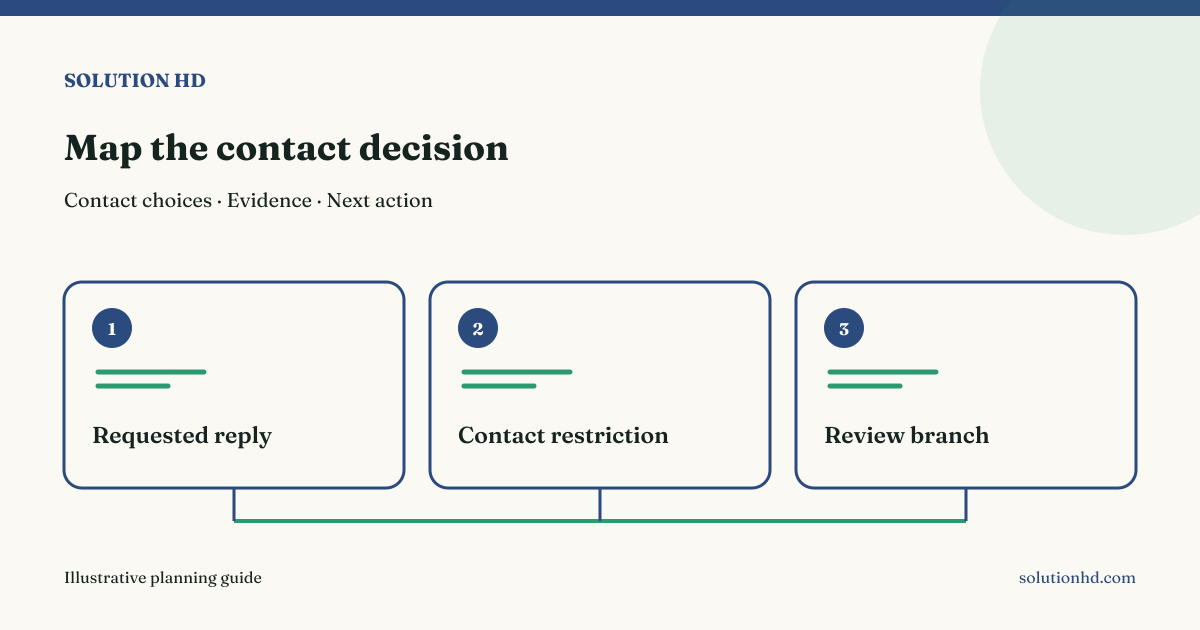
A custom call flow should not treat contact permission as a final checkbox. The answer can change the next step: requested reply, no text, an objection to calls, or a question that needs human review. Map those branches before writing the greeting.
Draw the decision points
Start with the caller’s purpose and the action the business proposes. For each possible follow-up, ask what permission or preference is required, where its evidence lives, and which team owns a missing answer. Keep service responses separate from optional campaigns in the diagram.
Test the exception path
Use illustrative cases: a caller asks for a quote but declines texts; another asks for no further calls after a transfer; a third gives an unclear answer. Decide which paths pause, which reach a human, and how the instruction reaches downstream tools. Have the actual legal wording reviewed for the business’s channels and jurisdictions.
Work through one case
Illustrative: Map a quote inquiry through three branches: an allowed requested reply, a stated no-text restriction, and an unclear permission record. For each, specify the next owner and what optional outreach stays paused. Then test whether a transfer or export drops the restriction before the next action.
A design branch must distinguish a caller’s preference from the legal basis for the chosen technology and purpose. These are acceptance criteria to verify during implementation, not evidence of an existing control.
Apply the questions to this example
Illustrative worked example: These sample notes extend the case above. Roles and record locations are proposed for the example, not descriptions of a customer or this brand’s configured service. Adapt them to your own process.
| Step | Question | Sample evidence, owner, and next action |
|---|---|---|
| 1 | Where does the follow-up purpose change? | The purpose changes when a quote reply becomes a promotional sequence; flow designer marks that decision explicitly. |
| 2 | What should happen when permission is unknown? | Review branch: optional outreach stays paused while the assigned owner checks the missing permission evidence. |
| 3 | Who owns a stop request after transfer? | Receiving owner after transfer: preserve the no-text instruction and verify affected exports carry it forward. |
Put the next step in writing
Bring these branches to the call-flow decision map. They are design questions, not evidence that a custom control is already configured.
Document these branches as design requirements to test. They are not a legal opinion on the completed flow; review the actual wording, destinations, and sending methods before relying on them.
Further reading: FCC call and text guidance · FTC telemarketing resources.
Contact Solution HD to discuss the inbound workflow described on this site.